
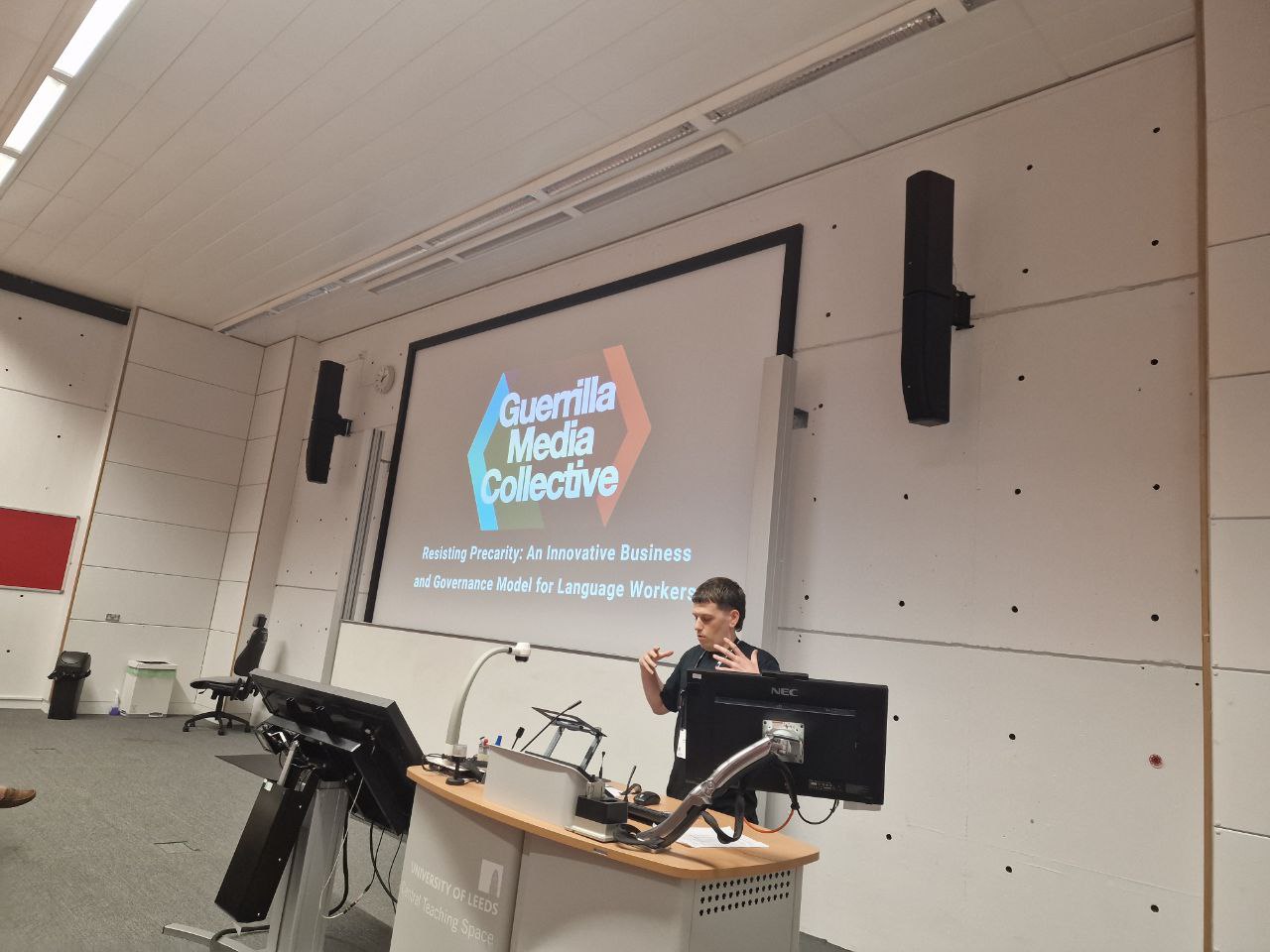
GMC live at the EST Congress in Leeds
On Wednesday 2 July, I attended the 11th European Society for Translation Studies Congress at the University of Leeds. Academic congresses are not something I’d normally go in for, but in this case I had a reason to be there: I’d been invited to speak on a panel, on behalf of this wonderful cooperative we call Guerrilla Media Collective.
We were invited to speak by our good friend Gökhan Fırat, who we know through both his activist work with Solidarity Economy Association and Translation Village, and his academic research into the translation industry. Before going any further, I would like to give him a massive thanks for setting this whole thing up. He approached us about it, set up the panel discussion, helped us draft our abstract, got it accepted through five rounds of peer review, and then workshopped the presentation over video call with me before chairing our session. This would never have happened without his initiative, and we are very grateful to him for getting us involved.
While I had planned and rehearsed my 15-minute talk ad nauseam, I didn’t give too much thought to the event itself, or who might be there. However, when I turned up on the day, picked up my name tag and milled around a big hall, I was surprised (though I probably shouldn’t have been) to see that I was one of the few people who was not from an academic institution. This was, I think, what made the day so special, and I would like to thank Gökhan again for his work in bringing non-academic folk like us into the academic sphere.
While there were many other panels going on, I spent the entire day ensconced in the room where ours – entitled “Changes to the Economic Value of Translation in the Face of AI” – was taking place. The other speakers were all fantastic, but highlights for me included Stefan Baumgarten and Michael Tieber’s consequentialist critique of the destruction of value in the translation industry, Yolanda Morató’s look at how professors can coach students in the economic side of translation, Félix do Carmo’s “Elephant in the room” analysis of the paradox of the translation industry’s economic growth alongside shrinking wages, and, of course, Gökhan’s research on the value of cooperatives in the translation industry, which we had participated in.
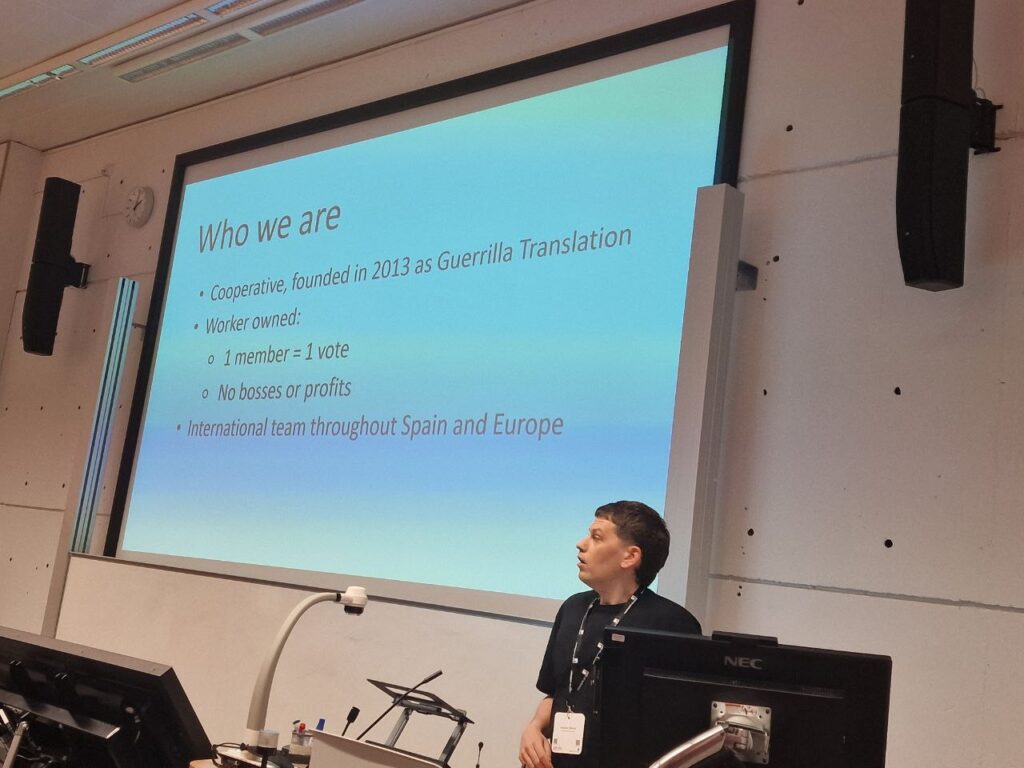
Despite jangling nerves, my own presentation went very well in the end. The title was “Resisting Precarity: An Innovative Business and Governance Model for Language Workers”, and I was able to clearly articulate how our model and governance systems help us to resist precarity. Instead of me listing through the content here, I’ve recorded a video of me doing the presentation at home for your enjoyment (and going slightly over the 15 minute limit, think of it as bonus content).
If you want a much greater level of detail on all of this, you can also check out our newly-revised handbook. This is the “beta” text-only version, but a much prettier version with all kinds of lovely images is currently in the works for later this year.
After the presentation there was a short Q&A session, and I was asked the interesting question of how our model could be applied to academia. My answer was that it would be a wonderful thing to see, but it would mean radically overhauling the way universities are operated and funded (though I should have also thought of alternative education projects like the Anti-University). The microphone was passed to other presenters, and the session briefly descended into a surreal scene of academics, standing in a lecture theatre in the bowels of one of the UK’s largest universities, delivering a stark critique of academia, including the solid, inarguable point from Stefan Baumgarten that every academic’s boss is effectively their national government’s finance minister.
My presentation was at 2pm, and throughout the rest of the afternoon people approached me to thank/congratulate/ask me about my presentation. Lots of them were very enthusiastic to have heard a non-academic voice at an event like this, and words like “refreshing” and “real person” were used on more than one occasion. I repeatedly made the point that Gökhan was the person to thank for that, as he had leveraged his academic position to bring me into this space, but I’m very glad that I was able to meet the moment.
The congress also prompted me to reflect on our collective’s relationship to academia. We have been quietly ploughing this “non-academic academic” furrow for a while now, participating in research and events that aim to bring academic thought down from its ivory tower and into the streets, to make it relevant to the lives of ordinary people. The Data Workers’ Inquiry, headed up by Milagros Miceli, is a great example of this, as it applies rigorous research principles to the exploited workers that underpin supposedly revolutionary tech. Likewise, the Doughnut Economics Action Lab presents complex economic structures in clear, concise and accessible ways, with the aim of inspiring others to build alternatives to business-as-usual capitalism.
I ended my presentation by pointing out that we would be fools to think a handful of cooperative members can solve the problems making the translation industry, and the world at large, such a precarious, hostile place. However, the value of what we do, both at the EST Congress and every other day, is that we prefigure the world we want to see. We don’t just theorise an alternative way of doing things, we inhabit it. Doing this won’t make the world any less precarious, but it strives towards a system where value is retained in the collective, where resources are distributed fairly among workers, and where care, support and humanity take precedence over profit.